Bugvirus: Unlocking the Nostalgic Pixelated World of Design
If you spent any time in front of a CRT monitor during the late 80s or 90s, the aesthetic of the Bugvirus font will hit you with an immediate wave of familiarity. It isn't just a typeface; it is a digital time machine. In a market saturated with sleek, high-resolution sans serif font options and elegant script fonts, Bugvirus stands out by deliberately stepping back into the lower resolution era. It captures the raw, grid-based construction of early computer interfaces and arcade cabinets, offering designers a tool that feels both technical and deeply nostalgic.
The Anatomy of a Pixel Typeface
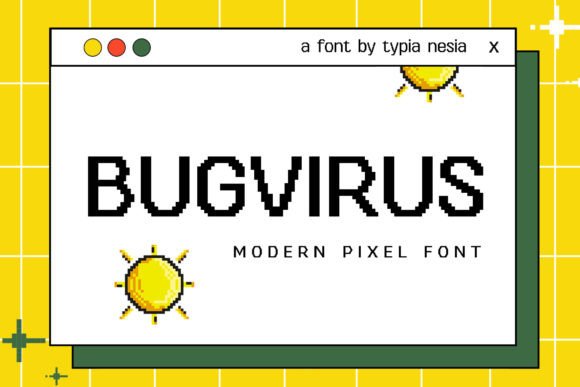
Visually, Bugvirus is defined by its rigid adherence to the pixel grid. Unlike modern typography, which relies on vector curves to scale infinitely, this premium font embraces the "stair-step" effect of early digital design. The characters are constructed with sharp, 90-degree angles, avoiding any anti-aliasing or smoothing. This gives the text a crunchy, tactile quality that feels authentic to the 8-bit and 16-bit era.
The personality of Bugvirus is distinctly tech-centric but playful. It doesn't carry the heavy, blocky weight of a generic "arcade" font; instead, it possesses a specific rhythm that mimics early code compilers or system error messages—hence the name. When you look at the letterforms, you see a perfect balance of negative space within the characters, ensuring that even at small sizes, the structure of each letter remains recognizable. It is a creative font that balances legibility with stylistic flair, making it an exceptional display font for headers, logos, and digital artwork.
Where Retro Meets Modern Application
One of the biggest challenges in web design and branding is differentiation. Using Bugvirus is an immediate way to signal a specific brand identity. For entrepreneurs and startups in the tech or gaming space, this font serves as a visual shorthand for "insider knowledge." It tells your audience that you understand the roots of digital culture.
Here is where Bugvirus truly shines in practical application:
- Gaming and Entertainment: This is the font’s natural habitat. Use it for game titles, HUD elements, or promotional social media graphics. It fits seamlessly into indie game logo design and merchandise.
- Editorial Design and Zines: For publishers creating magazines or blogs about retro hardware, cyberpunk culture, or tech history, Bugvirus adds an authentic layer of atmosphere to headlines and pull quotes.
- Packaging Design: Think of a craft beer brand with a "hacker" theme or a tech-focused snack box. Using a pixelated font like Bugvirus on the label creates a tactile, intriguing shelf presence that contrasts with the smooth textures usually found in packaging design.
- Digital Media and UI: While not suitable for long body text, it is excellent for user interface elements in apps that want a "gamified" feel, such as fitness trackers or habit-building apps that reward users with points and levels.
Strategic Impact on Brand Perception
Choosing a font is rarely just about aesthetics; it is about psychology. When you integrate Bugvirus into your brand identity, you are influencing how your audience perceives your message. The pixelated style suggests precision, logic, and a connection to the foundational layer of technology. It creates a visual hierarchy that demands attention because it breaks the monotony of standard corporate typefaces.
However, this stylistic choice comes with responsibilities regarding readability. As a display font, Bugvirus is optimized for impact, not for dense paragraphs. If you try to write a 500-word blog post entirely in Bugvirus, you will fatigue your reader’s eyes quickly. The "noise" of the pixel edges works against you at length. The strategic move is to use Bugvirus for your H1s, H2s, logos, and call-to-action buttons, while pairing it with a clean, highly readable sans serif font or even a simple serif font for the body copy. This contrast creates a dynamic font pairing that guides the eye naturally.
Practical Guide to Implementation
Adopting a commercial font like Bugvirus requires a bit of technical testing to ensure it serves your project well. Here is a practical checklist for designers and creators looking to unlock this nostalgic world:
- Evaluate the Grid: Pixel fonts often render best at specific sizes (multiples of the base pixel grid). Test Bugvirus at various sizes in your web design software. If it looks blurry, you may need to adjust your anti-aliasing settings to "None" or "Sharp" to maintain that crisp, retro edge.
- Check the Character Set: Before finalizing your logo design, check if the font includes the specific special characters or punctuation you need. Good design assets usually include a robust set of glyphs, but it is always best to verify.
- Review Licensing: Since you are likely using this for commercial purposes—whether it is a client's website, a t-shirt line, or a YouTube channel—ensure you have the correct license. A premium font license usually covers most standard uses, but if you are embedding it in software or an app, double-check the terms.
- Color and Contrast: Pixel fonts can sometimes bleed into busy backgrounds. Because Bugvirus has a distinct texture, it works best against solid colors or very subtle gradients. High contrast is key to making the pixel edges pop.
Ultimately, Bugvirus is more than just a typeface; it is a design statement. It bridges the gap between the raw, experimental days of the early internet and the polished modern typography